Mostrar mensagens com a etiqueta History in the Making revised -- Part 2 - Construction. Mostrar todas as mensagens

segunda-feira, 16 de março de 2015

History in the Making revised -- Part 2 - Construction III

To the sea where she belongs.
With ORIANA’s hull construction almost complete by July 1994 it was almost time for ORIANA to take her first steps into the outside world, this would give Meyer Werft chance perfect the manoeuvre when it would be required some months later for the installation of the funnel.
In preparation the final block of the hull was installed the bulbous bow
Before ORIANA could be moved one final calculation had to be made to work out the ships centre of gravity, this was achieved by what is called the preliminary inclining test, as the name suggests ORIANA would be inclined by a single degree.
With this preformed the date was set for ORIANAs first albeit short journey the 30th July 1994

Ready to take to the water 30th July 1994

Flooding of the dry dock took several hours but finally with the Meyer Werft tug ANTJE attending at her bow ORIANA was ready to move.
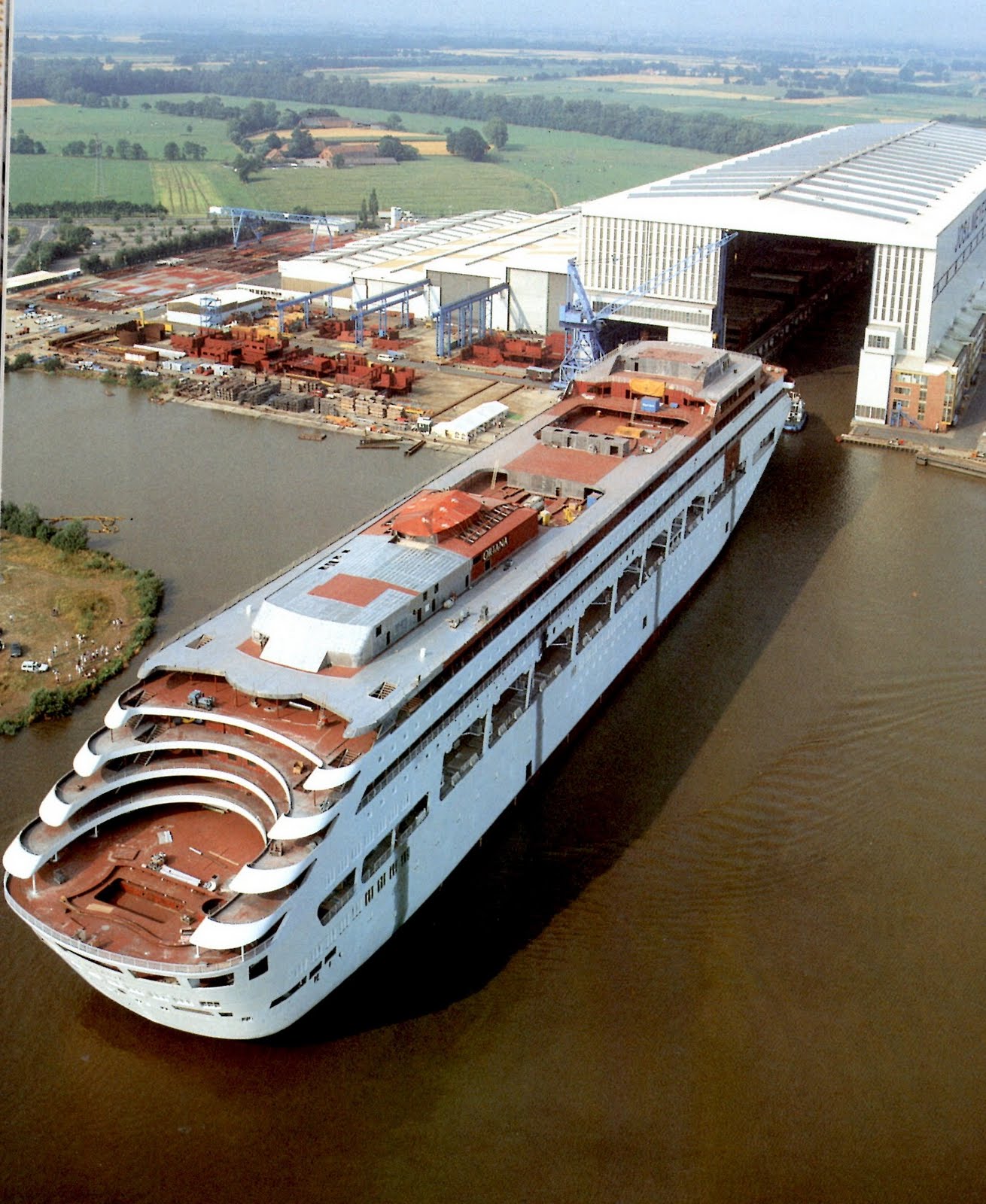
With many locals stood on the banks of the river opposite the yard looking on as ORIANA began to slowly move emerging first the elegantly designed stern proudly displaying the words ORIANA and LONDON
A slow process the whole move would take 4 hours as eventually ORIANA emerged seemed to continually grow larger with her upper decks only just clearing the ceiling of the building dock .
ORIANA begins to move
ORIANA towers above the attendant tug
Afloat for the first time!

Despite not having its funnel in place and the forward deck structures incomplete the hull was still a impressive sight.
Devoid of any of any decking and with only gaps in the upper decks and terrace where the pools would later be installed ORIANA did look somewhat curious but within days she would be retuned to the covered dock for work to continue.
While ORIANA herself floated for the first time P&O them selves were busy preparing for arrival in 10 months time,
The maiden seasons cruises had been drawn up and gone on sale with the maiden voyage selling out quickly, to be emblematic of the company history the itinerary for the maiden voyage would include ports of calls which had a long associations with P&O ships.
The first port of call would be Funchal, Madeira a port which P&O had visited since its earliest days, more recreantly since the mid 1980s CANBERRA had called regularly and spent most New Years eve’s in port allowing for the passengers to watch the world famous and record breaking fireworks display.
After a overnight stay and a fireworks display put on for her passengers the ship would depart for the Canary islands before heading to Morocco and Gibraltar turning back north the ship would call in mainland Portugal before heading back to Southampton.
Also of good news to the company was that Her Majesty the Queen had agreed to name ORIANA just as her cousin Princess Alexandria of Kent had 35 years before with the previous ORIANA .
P&O had also successfully campaigned for ORIANA to carry the call sign of her namesake and to this end she was assigned the call sign GVSN , this would be changed to ZCDU9 11 years later when the ship was reregistered to Hamilton, Bermuda.
ORIANA'S impressive and elegant bow

Once returned to the cover off the dock work commenced again, during this period using external generators some of ORIANA’s major systems were tested including a using zero thrust propellers to test the main engines as well the planking on the decks and some of the fitting out including the installation of the swimming pools and lifeboat davits.


With work in dock continuing and more of the fittings including the cabins ready to be put in place ORIANA quickly took on some resemblance of her final form.
 Finally on a cold snowy 7th January 1995 ORIANA was ready to leave her dock for the second and final time to have her funnel installed before being moved to the outfitting pier.


With outfitting underway ORIANA soon began to look like a luxury liner instead of a steel building site, with her cabins, public and crew spaces all being installed with specialist contractors working along side Meyer Werfts own staff to insure delivery in just 3 months time
A nocturnal shot of ORIANA during fitting out.
With ORIANA finally afloat the fitting out begun in the covered building dock took priority as the number of electricians and fitters on board greatly increased and almost daily the harsh shipbuilding environment of steel and welding gave way a world of soft furnishings and exquisite art work.
Never a easy process for owner or builder P&O made the most of the last months before ORIANAs completion with some of her designated crew training onboard CROWN PRINCESS to gain experience of a ship with roughly the same tonnage as well as in training simulators in Southampton
While Meyer Werft in preparation for the ships departure has approached the state government of Lower Saxony for permission to dredge the River Ems at Papenburg to a depth of 7.3 metres in order for ORIANA to depart, initially this was refused Meyer Werft then reproached for special permission just for ORIANA’s departure this was fortunately granted.
By February ORIANA was virtually complete all that remained was small finishing touches to be added which could be completed while the ship was on trials.
ORIANA at the fitting out pier almost completed

Also missing at this point was ORIANA's lifeboats being built by Mulder + Rijke in The Netherlands these would be delivered to ORIANA shortly before her trip down the river Ems to the sea.
Soon ORIANA would be ready to take her place as the newest and most advanced ship in world.
Photos copyright Meyer Werft and P&O Cruises.

segunda-feira, 9 de março de 2015

History in the Making revised -- Part 2 - Construction II

ORIANA takes shape
Within 2 months of the keel laying ORIANA soon began to take on her distinctive lines at the mid ships area the hull was already at deck 6 out of the eventual 14, the fast construction time was due to the a for mentioned prefabrication of modern shipbuilding with the blocks of the ship being constructed next to the building dock then when ready being lowered and welded into place.
In theory the blocks could be of any size, the limiting factor being the load limit of the overhead cranes  around 700 to 800 tons, the majority of blocks for ORIANA weighed around 450-500 tons.
In the case of ORIANA the ship is made up from 45 such blocks as seen below, the last of these blocks would be the funnel.

The heaviest block would be number 16 weighing in at 722 tons which would eventually house the main engines.
During this phase of construction in order to prepare for the later fitting out stage the spaces to allow for cabling, pipes and ducting etc. were pre cut.
Construction continues. The main engines are lifted into place.
While ORIANA herself grew at a fast rate in her birthplace other vital components also were coming together in other locations in Europe.
These included the ships stabilisers at the time the largest ever built.
ORIANA's stabilisers being checked.
The ships stabilisers work like aircraft wings extending out from the hull beneath the waterline during rough sea conditions they adjust their position to counteract the effect the waves effects on the hull.
Built by Brown Brothers of Edinburgh the company had over 120 years experience in marine engineering, before the development of stabilisers it had specialised in steering equipment among those it has built for were White Star’s famous Olympic class liners and French lines legendary NORMANDIE before building the first stabilisers in the 1930's.
The stabilisers journey from the factory to the docks in Leith ready for the voyage to Papenburg created quite a stir as they prepared to set sail for the first time.
  Other components being constructed and bring shipped to Papenburg included the sanitation system and onboard pumps all being supplied by Hamworthy engineering from Poole, Dorset on the south coast, the heat reclaim boiler from Senior Thermal engineering in Wakefield, Yorkshire, and from Italy the ship's 15 watertight doors.
By July 1993 ORIANA had reached ten decks in height at the mid ship area and work began on the installation of sections of the air-conditioning system.
Various components arrive while construction continues.
The forward section of decks 7,8 and 9 are lowered into place.


At 8 decks in height.
At 10 decks in height.
As ORIANA’ hull began to take on its final form many of the ships unique interior features including the statue and statuettes that adorn Harlequins dance venue and the wall mural in the Lords Tavern were being made ready, all being masterfully created by artists, Sculptors and metal workers, ORIANA would soon take her place as a interior work of art as well as a engineering triumph.

Artist Janet Shearer works on the Lords Tavern mural.


Sculptor John Mills at work on the Harlequin entrance statue.
  By April 1994 87% of ORIANA’s structure had been completed along with much of the pre-fitting out.
 On the 8th April one year and one day from her Maiden Voyage  Lord Sterling made his first visit to the yard to have detailed look at how the work was progressing and how ORIANA was shapeing up, as well as walking through her incomplete hull he also toured mock ups of her various rooms to give his input and opinions.
By May 92% of her steel was in place and the construction showed no signs of slowing down and work on her interiors was also well underway

After another 3 months of construction ORIANA was at last ready to make her first brief appearance into the outside world.
With final adjustments underway and many locals waiting to see their latest Masterpiece, Meyer Werft prepared for the first time to flood the building dock which until now had been ORIANAs home.
Soon ORIANA would take to her natural element and a famous name would float again.
Photo Copyright: P&O Cruises & Meyer Werft

segunda-feira, 2 de março de 2015

History in the Making revised -- Part 2 - Construction I

A Dream Starts in Germany

On the 20th January 1992 P&O officially announced that it had a month previously signed a contract for the construction of its new liner with Meyer Werft, while the ship entered its final design stages P&O assembled a team people to work on certain aspects of the project headed by project leader Jim Hunter they comprised of the new ships Chief engineer designate Marcus James, Purser Chris Bullen, specialist theatre designer John Wyckham and alongside them numerous other people from shipboard departments and P&O’s operations and marketing departments.
While that team began its work P&O began other preparations into the ships construction and assembled another team to work more closely with the shipyard, these included site manager Peter Bonham who would be on site with his team of inspectors to make sure the work met with P&O’s high standards.
P&O had already chosen the ships master, Captain Ian Gibb  who later be appointed Commodore was in preparation for the new role as ORIANA's first commander and was assigned to the recently completed Princess ships CROWN PRINCESS & REGAL PRINCESS being of similar tonnage to the new ship the experience would prepare him for his new role.
Speaking about his time leading up to ORIANA's introduction to service he said,
"I spent some time with Princess on board one of their ships, I don’t recall which, to gain experience on board a larger ship and with the newer systems there and I also went out with the pilot to QE2 in Southampton to observe her being brought in."
He and future Chief Officer Hamish Reid would also spend some time during the construction at the Meyer Werft yard as Ian Gibb recalls their different experiences in Germany.
"I actually lived in Germany for a time during the construction as did Hamish Reid my Chief Officer so we were on site a majority of the time, Hamish had travelled out before I did and was living with a German family and his German improved greatly, I was stayed in a hotel so mine didn’t."
  Meanwhile to ensure the final designs were what was required two models of the ship, one 3 metres in length and the other 8 metres, these were taken to Trondheim, Norway for testing in one of the largest testing tanks in Europe, with further tests being performed on the aerodynamics of the designs gas emissions and the proposed anchor in Vienna.
10 months after the contract was signed and all design work almost complete on the 4th October 1992 the first steel was delivered to Meyer Werft where it underwent numerous inspections by Bonham and his team he explained “P&O is a very demanding client which wants first-class ships built”.“Classification societies such of Lloyds are employed by the shipyards but I and my inspectors are independent, there at the request of the client.”
Although it had some experience of modern shipbuilding with its subsidiary Princess P&O had not ordered a new ship for its UK service since 1956 when the order for CANBERRA had been placed with Harland & Wolff, in the years since then shipbuilding techniques had radically changed.
When the previous ORIANA and CANBERRA were built although being of very different design the basic construction of the two ships was the same, the majority of the hull being built in the traditional manner of steel riveted hull plates with larger welded aluminium superstructure.
The new ship would be built using newer prefabrication methods in Meyer Werft’s enclosed building dock as ship number 636.
Building dock 1 © Meyer Werft
While the preparations at Meyer Werft were almost complete there was one vital area which had so far received little attention: the engines.
For this they looked to MAN B&W in Augsburg, who using a state of the art computer system calculated the best engine system for the ship.
It suggested a so called father and son arrangement of 4 medium speed diesel producing 39,750kW at 428rpm to supply the propulsive power, with a further four auxiliary engines developing 4,420kW to supply the mains electricity for the ships A/C machinery and hotel services.

Construction begins
 As the sun rose on the 11th March 1993 it did so on the first day ORIANA’s official existence, later that day a group of around 100 people gathered on the floor of the building dock before them stood the first block of 636.
The keel is laid
Keeping with tradition P&O’s Tim Harris placed a 1 pence coin onto the keel and Meyer Werft Bernard Meyer, Chief executive officer placed a 1 Pfennig coin.
P&O's Commodore John King and Managing Director Gwyn Hughs with a Travel Agent rep
Both giving speeches Harris took the opportunity to officially announce the name of 636, ORIANA.
He concluded by saying “ ORIANA will lead in terms of design, elegance and passenger comfort” and that “She’ll epitomise everything that is best about Britain”.
As the assembled guests prepared to head off for celebration lunch a brass band also in the dock played for the occasion playing both Deutschlandlied and God Save the Queen as well as big band music.


 ORIANA's designers share a light moment
 With the guests leaving the dock to celebrate the next block of ORIANA was lowered into place slowly at first but surely the great ship began to grow. 


ORIANA begins to grow
With the name now know by the public reaction was varied especially among the fans of the previous ORIANA, to some it was great news a new ORIANA to sail the oceans of the world to continue the legacy of her predecessor while to others they felt that the new ship no matter how well built would not be able to live up the previous one's reputation.
With the construction underway P&O began to publish publicity material including sending existing passengers booklets regularly covering the design and what passengers could expect when the ship was completed more infomation on these can be found here
It was also at this time with computer generated images that the public could see what the completed ORIANA would look like.
Computer image of ORIANA © P&O Cruises

Once construction began the pace quickened, by May 1993 2,000 tonnes of steel was in place, by July 4,036 tonnes ; by November 7,762.
11 months after construction had began 10,845 tonnes of steel had been erected roughly 68% of the total steel used for the ship.
Soon ORIANA would take on a shape that would come to be identifiable and loved worldwide.