Mostrar mensagens com a etiqueta History in the Making revised Part 3. Mostrar todas as mensagens

segunda-feira, 6 de abril de 2015

History in the Making Revised -- Part 3 -Delivery and Christening III

“I name this ship ORIANA.”
With ORIANA completed and delivered to P&O, all that remained was to deliver the ship to her home port of Southampton where in a spectacular and fitting ceremony she would be named by Queen Elizabeth II. For P&O this had been a long held dream of having the reigning monarch name their flagship, although the company had many royal connections , it had the distinction of being the only British shipping company to have been founded officially by Royal Charter from Queen Victoria in 1837, it also had been given permission by the royal houses of Spain and Portugal to use the colours of their flags.
It had been initially planned that Her Majesty was to name CANBERRA at her launch in March 1960 but this was changed with the birth of Prince Andrew in February the same year.
While preparations were underway in Southampton ORIANA with her crew for the first time in charge of her, bid goodbye to land of her birth and to Emshaven as the ship headed out into the North Sea this time to take southerly course through the English Channel on route to her new home. Due to the heavy sea conditions that ORIANA had encountered during her sea trials which had resulted to in a rescheduling of some of the trials, this meant that her departure was later than had first been anticipated.
Commodore Gibb on the bridge.
For Commodore Gibb and his crew the moment they had waited months for had come ORIANA was finally  bound for her home port under their command.
Being only a short journey ORIANA was expected to arrive the next day, for the remainder of the day and night ORIANA navigated through the English channel passing the east coast of the British mainland to starboard and the Dutch/Belgian coast to port. Onboard were a few shipyard workers who had a few final fittings to complete and check, also the ship's first photographers preparing their onboard shop and photo printing room.
While elsewhere on board the ship's crew were preparing for the first visitors and passengers she would receive in the upcoming weeks and months from the restaurants where the waiters were preparing with last  minute cleaning and fine tuning their service to the Theatre Royle where ORIANA's very own theatre company were polishing their performances the story throughout the ship was the same ORIANA was ready to meet her public for the first time.
During the early hours of the morning ORIANA slowed as she approached the Nab Tower Lighthouse in the Dover Straits marking entry into the Solent. Embarking the pilot for the first time ORIANA continued slowly ahead, as day broke curious spectators watched as at first light the ship continued to make her way up river towards Southampton. As is tradition when a new ship arrives in Southampton local people, ship enthusiasts and photographers took yachts and small boats out to greet and escort the ship into dock while at her bow tugs gave a traditional water hose welcome. For the first time many of P&O’s and CANBERRA’s loyal fans were able to view her in person as the historic port welcomed the worlds newest and finest passenger liner.
On an overcast Southampton morning ORIANA arrives.
 Along with the officers and harbour pilot Lord Sterling was also to be found on the starboard bridge wing being interviewed he summed up the general feeling on board.
Due to the ship arriving later than was planned the next three days up until the naming would be a busy period of last minute preparations and arranged visits and over the next five days would have a heavy schedule of events going on onboard which would see 10,000 visitors enjoy ORIANA’s hospitality. As was expected ORIANA attracted much media attention including interviews with members of P&O’s management and the ships crew among them Commodore Gibb, Speaking of his anticipation of the maiden cruise he said “ Funchal in Madeira is one of our favourite ports of call, there’ll be a great welcome, with a half a bottle of Madeira wine for every passenger and corsages of local flowers- and the weather is almost always sunny too.”
However before the maiden cruise there was the important matter of the naming ceremony which was set for the 6th April an event like no other the naming is always ranked as one of the most memorable in the life of a ship and P&O certainly wanted ORIANA’s to as special as possible. 
For those who had been lucky enough to stay onboard over night and those arriving early the day started with a classical music presentation which was held in the Crows Nest bar followed by recitals in the Pacific Lounge. Afterwards they joined the later arrivals on the dockside where they took their seats on the specially installed seating which had been set up next ORIANA for the occasion. All being seated by 11am the guests were honoured by musical entertainment supplied by the Band of HM Royal Marines until Her Majesty arrived. From behind as the band played, the Royal Train from London could be heard pulling into the station. With cameras filming to broadcast the occasion to the world and The Choir of Westminster Abby singing Fair Oriana, Beauty’s Queen, Her Majesty The Queen and His Royal Highness Prince Philip The Duke of Edinburgh took their places on the podium in front of ORIANA and on ORIANA's promenade deck he officers lined the rail watching the gathering below
Before the ceremony began and as is always the case when Her Majesty is present the choir of Westminster Abbey led the singing of the National Anthem and the introduction were made by the Master of Ceremonies, then followed the playing of Fanfare to ORIANA a piece of music which had been composed by the famed composer Benjamin Britten for the launch of the previous ORIANA. After the music finished speeches were made by the chairman of Associated British Ports and Lord Sterling, concluding with the ship being blessed with holy water by the Bishop of Basingstoke. With Commodore Gibb and Lord Sterling looking on Her Majesty made short speech before saying the words that in the English language are so associated with ship naming ceremonies -“ I name this ship ORIANA, may god bless her and all who sail in her.” she pulled the leaver sending the bottle champagne smashing against the “I” in the ships name as ORIANA’s horn blew enthusiastically much to the excitement of the crowd many of whom admitted later of having a tear in their eyes.

  After the naming its self Her Majesty went onboard ORIANA to dine and for a tour of the ship and lunch on board as did many other guests. Including many areas the paying public would never see including the navigational bridge.
Her Majesty is shown the ships plaque. On the bridge.
While touring the ship Her Majesty showed a particular interest to the Children's and Teenagers areas where she met a young Girl named Oriana who had wanted to meet her.
Recalling the tour Ian Gibb  felt it was a success and in particular related two stories he had of it
"I think she was impressed with the ship, she certainly appeared to be. There are two memories in particular I have while touring the ship, the first was while she looking round the Spa & Fitness areas she joked while observing the Exercise Machines that “we have these in the dungeon at Windsor Castle!” and sometime later while touring the ship's Galley the executive Purser had selected 10 or 11 members of the restaurant crew to introduce to her to and as it turned out they all had the surname of Gomez so I was walking down the line introducing each saying “This is Mr Gomez and this is Mr Gomez and this is Mr Gomez as well”
To complete what had been a perfect day as night fell a full pyrotechnic display was arranged by P&O to celebrate in the grandest possible way the arrival of ORIANA- Queen of Seas.

Celebration fireworks.
And so the first chapter of ORIANA’s story came to a spectacular end ORIANA had gone from concept -Gemini, to a solid reality speaking of the relevance of the new ship John McNeece said "She will be the benchmark by which all others will be measured", in 3 days she would depart on her Maiden Voyage and Madeira where a warm welcome awaited for her first landfall.

ORIANA in the most fitting and Majestic way possible had truly arrived.

Photo and Video  Copyrights: P&O Cruises.

segunda-feira, 30 de março de 2015

History in the Making revised--Part 3-Delivery and Christening II

Sea trials in the North Sea.
March 1995:- After a more or less successful journey from Papenburg and a short stopover at Hamburg for a hull inspection ORIANA was at last ready to head out to sea to prove the ships technical systems.
The Trials would take place over the course of 10 days and would test all aspects of the ship including: Stopping distances at different speeds, manoeuvrability, deployment of lifeboat and testing of lifesaving equipment, effectiveness of the stabilisers and of course a full speed run to see what top speed ORIANA could actually achieve.
Alongside members of the crew who had joined the ship many shipyard workers remained onboard to continue with the remaining fitting out tasks such as adding the balcony dividers and fittings such as artwork and some light fixtures.
Among those onboard ORIANA anticipation was high, finally after years of planning and designing the ship was a solid reality a new flagship ready to begin what would be hopefully a long career and to be the latest showcase of P&O’s high levels of service.
Although many different tests had been preformed on the ship's design during the later planning stages it was not until now that P&O would know exactly how ORIANA would perform.
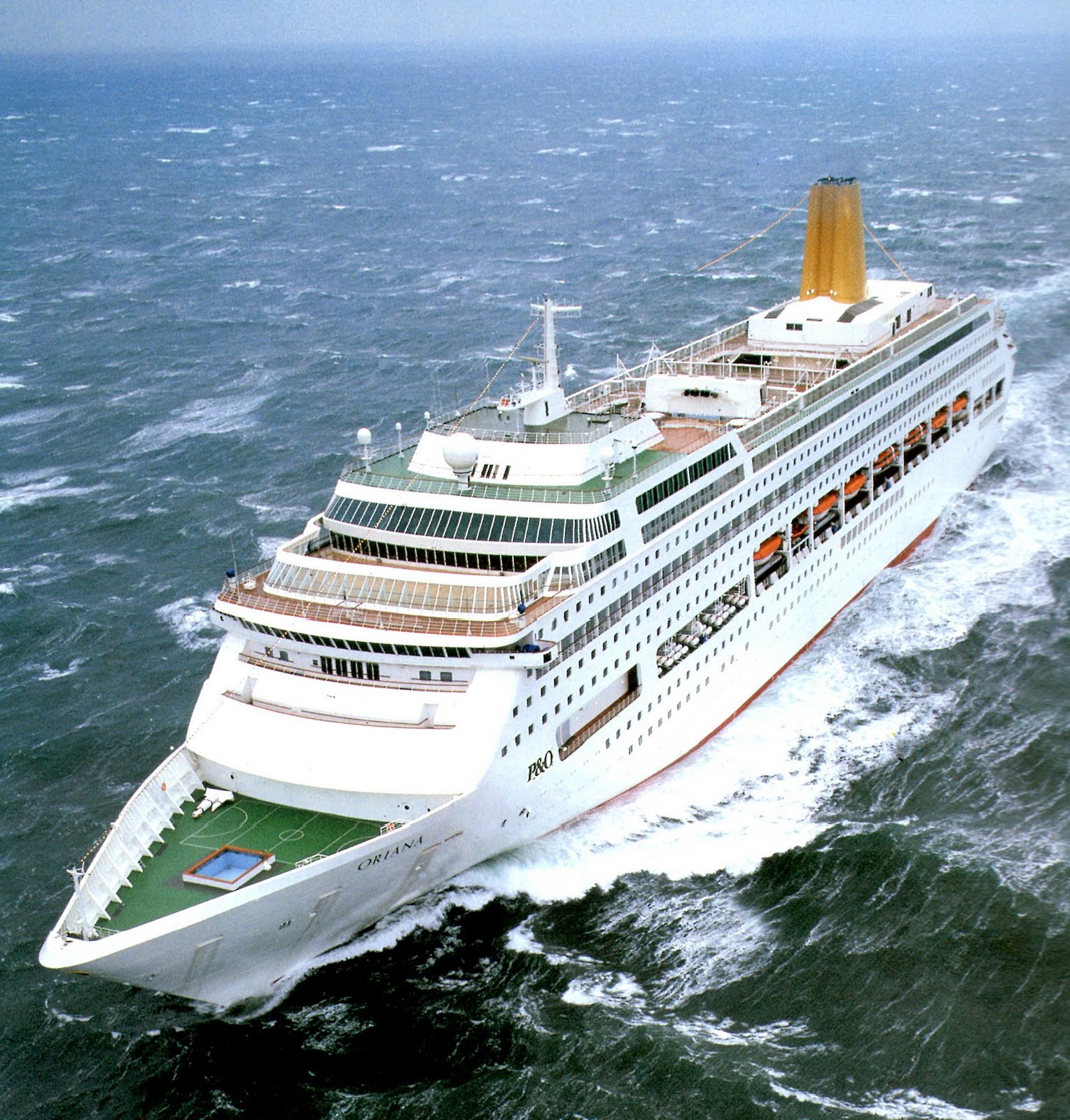
As ORIANA took to the high seas for the first time the weather took a turn for the worse the sea conditions deteriorated rapidly and soon the ship found herself in conditions which certainly would be a test for her sea keeping abilities.
At this point still technically a German ship Commodore Gibb was still on board as a observer with the trials being handled by a shipyard Captain.
As a sign of early promise with the aid of the stabilisers ORIANA only rolled by a about 3 degrees in either direction much to the pleasure of those aboard.
Many commenting on how despite the heavy seas how the ship kept a steady course throughout.
The work that had gone into making ORIANA suitable for all season cruising seemed to have been worth it as her deep sharp angled bow deflected the North Sea's ferocious waves like her great predecessor ORIANA showed herself to have excellent sea keeping abilities.

On a rough North Sea March 1995
To ORIANA’s crew the new ship with greater manoeuvrability than was available on CANBERRA was a delight to operate.
Commodore Gibb commented “Everyone who knows me knows of my affinity for CANBERRA but with her you had to plan every manoeuvre 10 Minutes in advance whereas with ORIANA everything is instantaneous.”
Also being demonstrated during the trials was the great range of speeds available to the ship using the variable pitch propellers from full head ORIANA was able to be ordered to full stop or full astern within a matter of seconds by just inverting the angle of the propellers’ blades instead of fully stopping and reversing the engines.

Chief engineer Marcus James checks one of the engines.

As has been discussed in previous posts a important requirement for the ship was speed , 24 knots had been calculated to be the required maximum speed for the ships role, faster than any passenger ship built since the 1960s but slower than the later Ocean Liners.
With the engines checked, Propellers set for maximum efficiency for the first time the main engine controls on the bridge were set Ahead Full and for the first time ORIANA’s engines run to maximum as expected 24 knots was easily achieved and surpassed as with little effort 25 Knots was in turn passed a speed which CANBERRA had not operated at for a number of years due to high fuel consumption.
In the rough sea conditions at full ORIANA quickly surpassed 26 knots and eventually made 27.2 knots with predictions that in more favourable conditions a far higher speed was a high possibility.
Of the engine system James commented “ ORIANA has been a major challenge her engine technology is completely different to CANBERRA”
Having also served onboard the 1984 launched ROYAL PRINCESS he said “ I will have no more staff onboard ORIANA than I had on ROYAL PRINCESS despite the substantial size difference of the two ships”
“This is due to computerisation, ORIANA is a ship that has been designed for the 21st century”
It was during the speed trials that it was found that the stern was prone to severe vibrations when the ship was running at higher speeds, as Commodore Gibb explains,
"the vibrations were a major problem the decibels that were being produced in the aft end were truly awful in the aft (Oriental) Restaurant crockery and cutlery was vibrating off of tables, after further trials we found the vibration was caused by the propellers at high speed and for a while it was not even certain we would accept the ship but we were assured the problem could be remedied by having the propellers replaced and in the short term by operating at slower speeds around 22 to 24 knots so we could control the situation."
In keeping with SOLAS while not at sea each of ORIANA’s life boats were lowered to check that both they and the lifeboat davits are in full working order and the crew deployed the rescue crafts housed in the second lifeboat recesses of the promenade in order to train for the unlikely event of a emergency.
Commodore Gibb (left) tests ORIANA’s life saving equipment.

During the course of the trials every system had been repeatedly test to ensure it was 100 percent operational from safety systems such as Watertight doors and swimming pool emergency drainage to external lighting and the ship's onboard public address system.
Alongside the crew  representatives from P&O themselves, Lloyds the company's insurers and the UK government marine safety agency were also on board to insure that all the condition were met in order for ORIANA to enter service in only 2 weeks time.
Sea trials continue 

Between the days spent at sea ORIANA sailed to Hamburg for drydocking to ensure everything below the waterline remained in order during these spells in drydock many of the supplies and crew arrived on board, including uniforms for those joing her.
Completing her trials and being signed off  ORIANA sailed from Hamburg down the Elbe and back to the Ems and the town of Emden ready fo her hand over in two days time.
P&O and Meyer Werft were now completely satisfied with the quality of the ship returned to Emshaven where on the 2nd April 1995 ORIANA was official handed over to become the property of P&O Cruises to mark the occasion the Meyer Werft company flag which had flown over ORIANA during her trials was lowered for the final time and raised in its place for the first time P&O’s historic house flag.
With all the crew Lord Sterling and Gwyn  present P&O cruises chairman Tim Harris and Meyer Werft’s Chief executive officer Bernard Meyer sighed the ships papers to say that ship 636 ORIANA had been completed as per the owners specification and that it met with their approval.

Officially now ORIANA was Commodore Gibb's responsibility, his first task to deliver her safely to Southampton for her naming in 4 days time.
Photos Copyright: P&O Cruises & Meyer Werft.

segunda-feira, 23 de março de 2015

History in the Making revised--Part 3-Delivery and Christening

Crossing Emshaven

By February 1995 two months ahead of ORIANAs maiden cruise she was ready to make her way from Papenburg to the North sea and ultimately sea trials to prove the technical systems.
This journey would take the ship 40kms to Emden where she would remain overnight before heading out for ten days of sea trails,
Due to the tide in the Ems ORIANA would make a stop at the town of Leer for several hours to allow for the tide to rise the water level high enough for the ship to continue the first albeit short trip down river to Emden.
Map showing ORIANA's route to Emden
Her lifeboats and tenders which had not been in place for long were once again lowered from their handling gear in preperation for the ORIANA's first voyage and would follow ORIANA down river.
As Commodore Gibb recalls "We also had the lifeboats lowered and they followed our progress down the river like ducklings following their mother. It was quite a sight to behold as it seemed much of the time from the moment we left Papenburg locals came out to watch ORIANA pass by I think it must have been tens of thousands people"
  In the morning with the Dutch registered tug WATERMAN in attendance ORIANA or for official purposes still ship 636 began her first journey with over 2,000 local residents from Papenburg including shipyard employees and their families to watch the ships departure, a sight ORIANA and her crew would witness many times over the coming months.
Although Commodore Gibb was on board he would be acting as an observer, for the time being ORIANA was officially the charge of the shipyard captain since at this time the ship was still the property of Meyer Werft, the handover of ORIANA would only be completed once the sea trials had concluded and P&O confirmed that the ship met with their requirements.
In theory it would be possible for P&O to refuse delivery of ORIANA if for example the ship was unable to develop the speed which had been set down in the contract .

ORIANA departs from Papenburg.

Slowly with the tug ready to assist the ship edged slowly out of the dock entrance firstly passing through a raised bridge.
An extremely, delicate and tight manoeuvre with less than a metre of water beneath the hull and barely a metre between the bridge and the ships sides ORIANA squeezed though, with the slightest breath of wind the ship could have been pushed into the bridge.
The bridge behind them ORIANA moved slowly onward attracting many people from both the German and Dutch border to watch this latest masterpiece in its natural element.
All seemingly going well a slight incident occurred when the ship temporarily grounded, with apparent damage and no possibility at the time of retuning to the builders the ship headed on the decision being made that a examination would be made at another yard once the journey was completed.
" Unbeknownst to us at the time we had struck bottom momentarily during passage, We only discovered that the ship had grounded when we entered dry dock for a regular inspection no damage had been sustained only small area of paint had been removed."
 Arriving at Leer in the afternoon to dock and wait for the tide to raise to a high enough level for the journey to continue, ORIANA looked resplendent with her gleaming white hull looming over the small town and like at her departure form Papenburg the great ship drew the crowds to look at her.


By the time the tide was high enough for ORIANA to continue on her way the light was fading fast and the next leg of the journey would continue by night.
With her lights and funnel fully illuminated ORIANA once again set out on route to Emden making as impressive sight by night as she did by day.
The most unique image that can be seen with a delivery trip from Meyer Werft is of a ship crossing over rather than under a bridge,
Occurring on the Ems Tunnel which allows for the A31 motorway to pass under the Ems.


Nearing her final destination of the day ORIANA slowly slipped into dock later that night where once runited with her lifeboats she would remain until the morning.
With only the slightest of problems ORIANA’s first ever journey had been handled well.
The next morning ORIANA left Emden as had been planned but unlike the original intentions ORIANA headed to the renown shipyard of Blohm & Voss for a inspection as a result of the grounding the day before.
After a brief stay in order to perform a extensive inspection for damage to the hull ORIANA departed the Hamburg yard for the North Sea for her 10 days of sea trials.

On route from Hamburg 
Soon enough P&O would know if the millions they invested in ORIANA had been worth it.
For Meyer Werft they had build the largest and most prestigious ship built in Germany for 80 years and with ORIANA's departure had created quite a spectacle it could be said that for the yard she was the first of many large ships that would bring fame to the Papenburg yard including her near sister AURORA just over 5 years later.

Photos Copyright P&O Cruises , Meyer Werft and Oliver Asmussen.